What does the nursery name tell us?
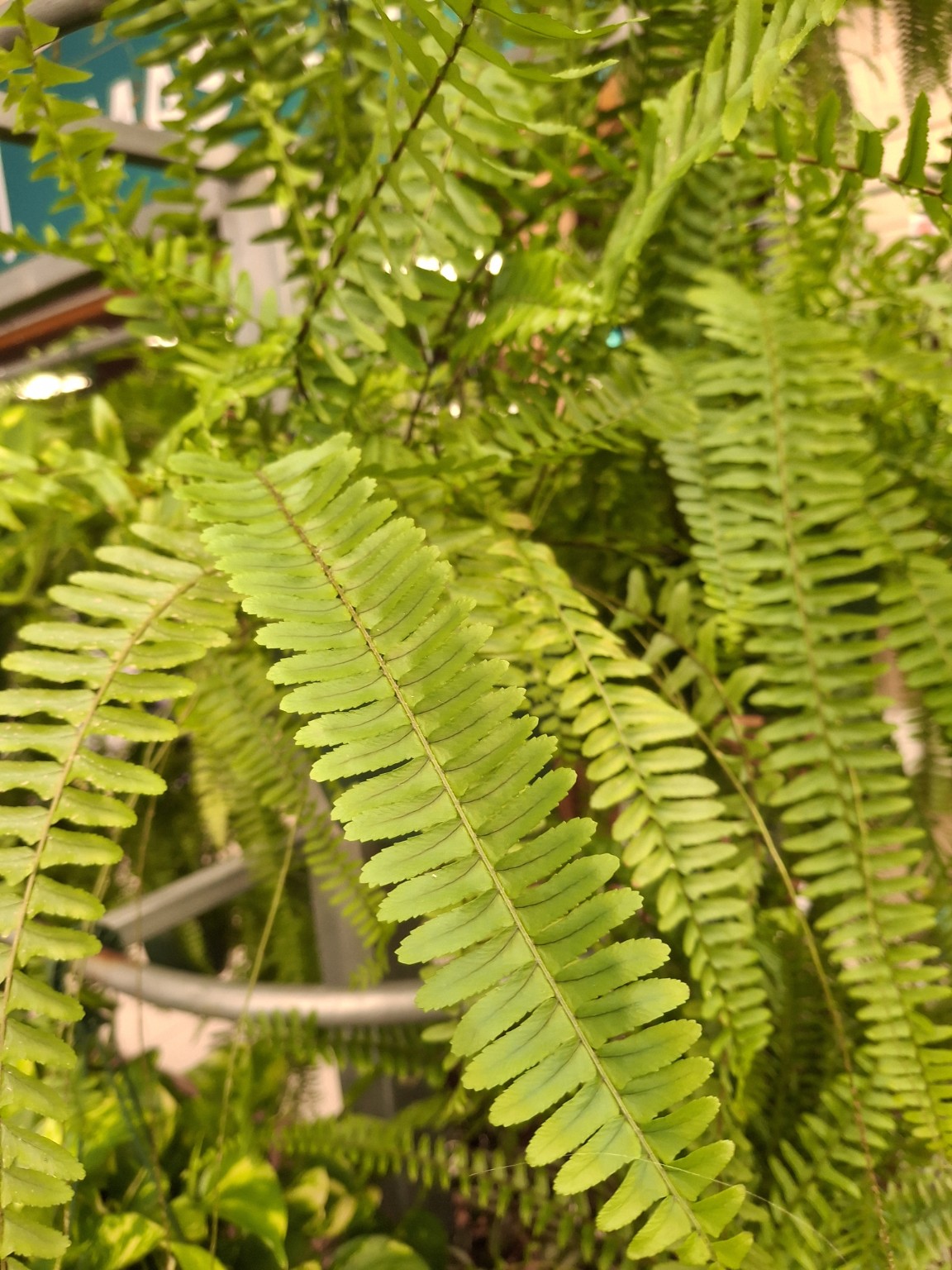
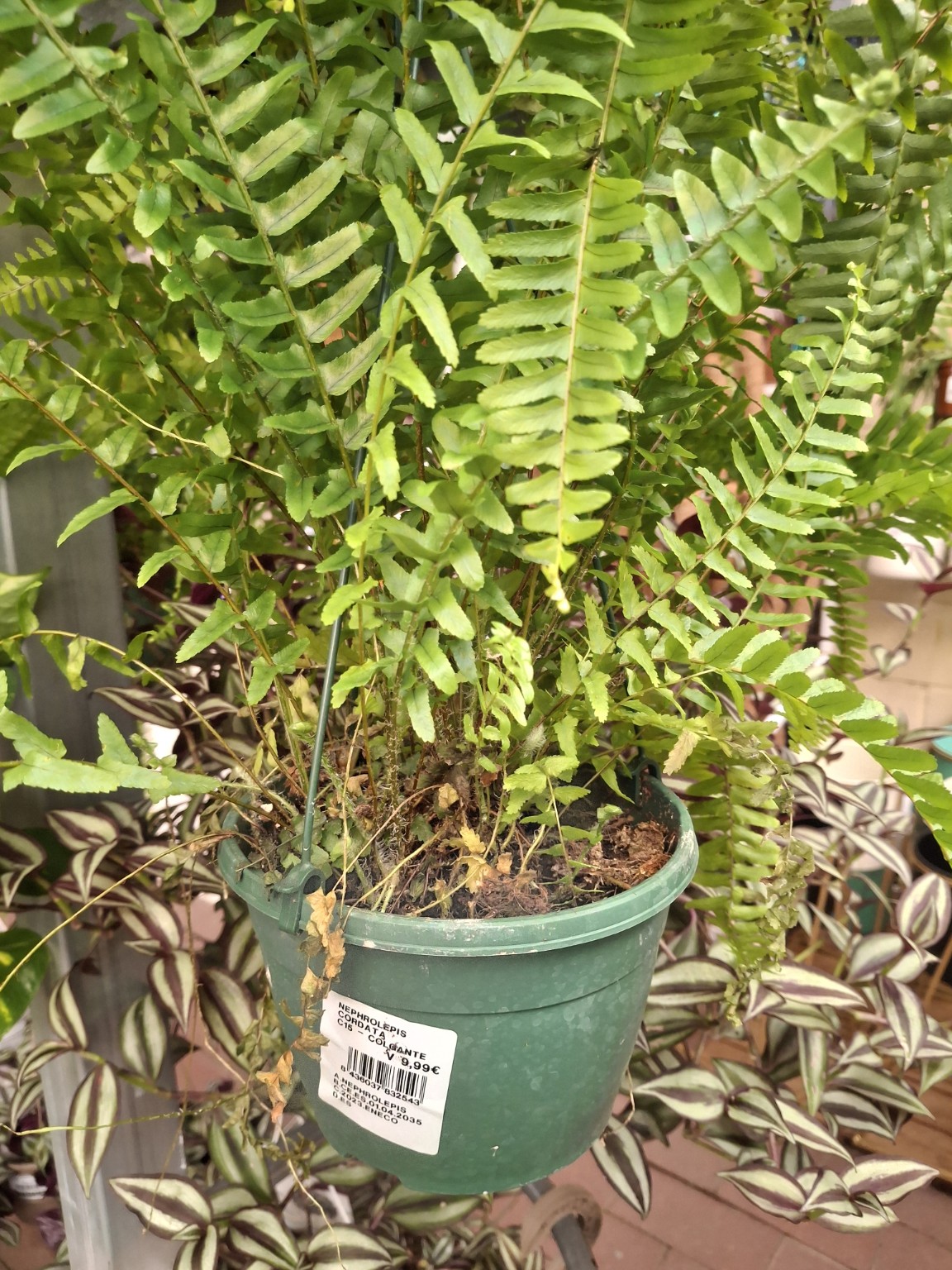
The plant in these photographs was sold as Nephrolepis cordata. Spanish nursery catalogues use "Cordata" for plants listed as Nephrolepis cordifolia, known as fishbone or tuberous sword fern. We use that as a provisional identification here: the retail label is documented, but the species has not been independently confirmed.
This matters because Boston fern, N. exaltata and its cultivars, is a related plant rather than an interchangeable name. The advice below concerns a potted Cordata-type Nephrolepis, drawing on care guidance for N. cordifolia. It is not a guide to every plant sold as a fern.
For a firmer identification, specialists compare leaflet bases, scales on the central stalk and reproductive structures. Tubers can be a useful clue in this group, but their absence does not rule out N. cordifolia. There is no need to disturb a nursery plant merely to look for them.
See the nursery label
Bright shade still needs a window
Indoors, give the fern bright, filtered light. A position near a window with protection from harsh direct sun is a practical starting point. Dense shade may leave it with little energy to replace older fronds.
Check the height of a hanging basket. A bright room can still be dim above the top of the window, and nearby ceiling-level air may be warmer. Bring the foliage into useful light without suddenly moving a shaded plant into strong sun.
Keep moisture available without soaking the roots
Aim for lightly moist, well-drained mix. Check when the surface starts to lose its damp feel, then feel below it and lift the pot. Water before the whole root ball becomes dry; wait if the interior remains wet and heavy. This is different from the longer drying period used for aloe.
Water the mix evenly, let it drain, and empty any outer container. A hanging pot needs accessible drainage too. Take it down if that is the only way to check its weight, the center of the mix and any water trapped beneath it.
If water rushes straight through but the center stays dry, investigate an overcrowded root ball or mix that is difficult to rewet. A brief bottom soak can help rehydrate dry mix; remove the pot once moisture has reached the root ball and drain it thoroughly. Do not leave it soaking as its normal growing arrangement.
Water demand changes with temperature, light and growth. Check less thirsty plants carefully during darker periods rather than applying a fixed winter timetable.
Humidity and the air around the fronds
Moderate to high humidity suits this fern, alongside gentle air movement. Avoid a radiator, heating vent or draft blowing directly through the fronds. Persistent leaf wetness in a cramped, poorly ventilated position is not a substitute for humid air.
A small hygrometer can help establish whether the room really is dry. Where needed, a humidifier provides more sustained control than occasional misting, which changes humidity only briefly. Keep airflow around the plant and avoid creating condensation on surrounding surfaces.
Repotting and feeding
Choose a moisture-retentive houseplant mix that still drains freely and a pot with drainage holes. Repot when the root ball is crowded and it becomes difficult to keep it evenly moist. Move up modestly in size, or divide an established clump if you want smaller plants.
Do not bury the leafy crown more deeply than before. Keep the pot easy to lift or take down: being able to check it is more useful than a large decorative container that hides standing water.
Use a dilute, balanced houseplant fertilizer during active growth, following its directions and taking any fertilizer already in the mix into account. Stop trying to feed a declining fern back to health before checking its roots and moisture. Excess salts can injure leaf margins.
Dry tips, yellowing and falling leaflets
A fern can shed leaflets after drying too far, but adding water automatically can make a wet-root problem worse. Check the mix first, then look at where the damage is occurring.
- Dry root ball and brittle foliage: restore even moisture, then review whether the pot dries beyond your checks.
- Wet mix and continuing collapse: inspect drainage and roots. Soft, disintegrating roots or a decaying crown require attention; more water is not the answer.
- Damage on exposed fronds: review sun, heated air and fertilizer history. Several stresses can leave similar dry edges.
An isolated old frond is different from rapid loss throughout the plant. Remove fully dead fronds with clean scissors near their base, taking care around emerging growth. Existing dead patches will remain; look for healthier new fronds and less ongoing damage.
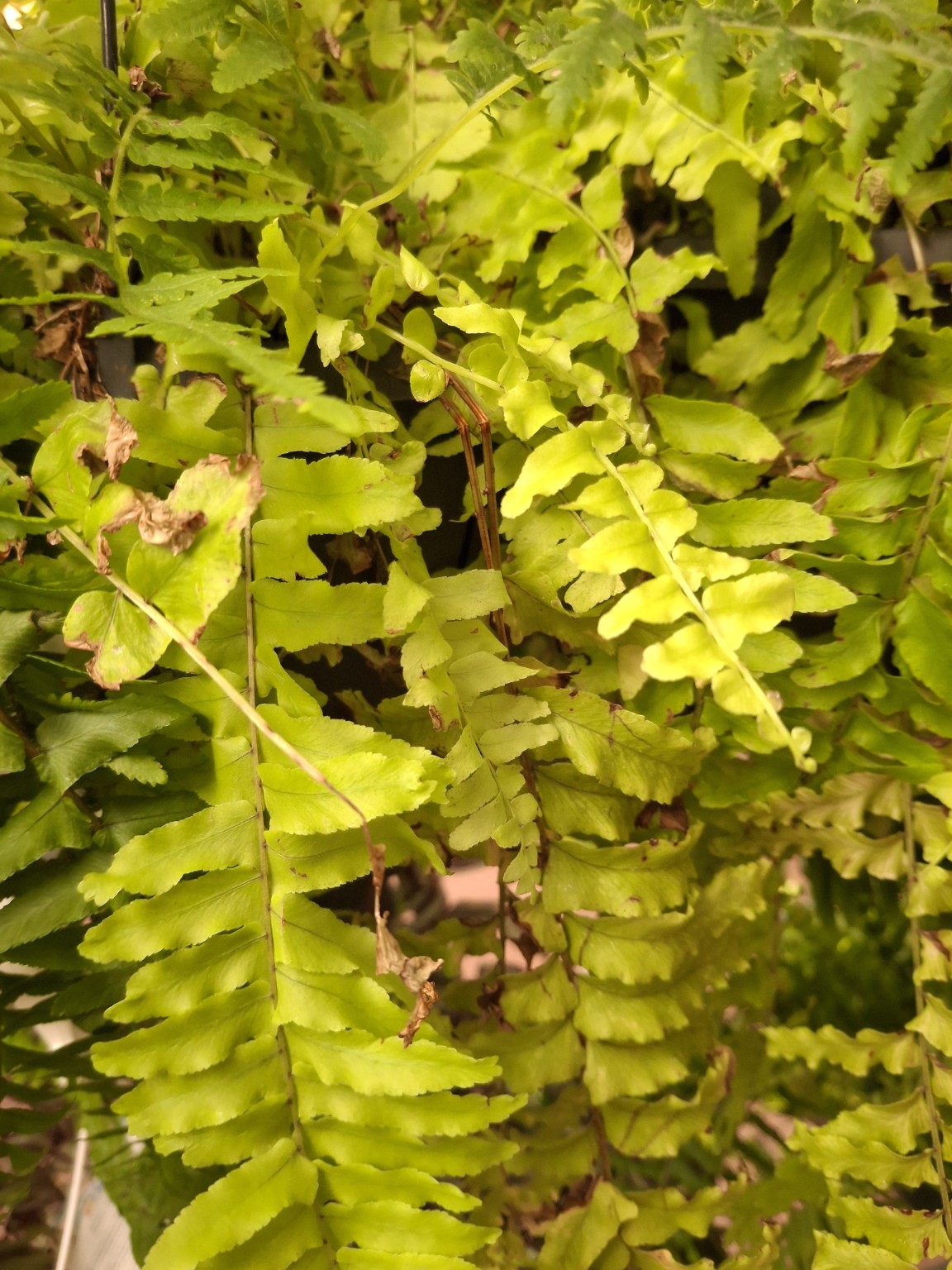
Inspect unusual marks closely. Orderly clusters on the underside of mature fern fronds may be spore-bearing structures. Sticky deposits, cottony material or insects need a separate pest check. Do not scrape or spray every brown mark as though it were scale.
Divide an established clump
Division is a practical option once the fern has healthy growth and enough roots to share. Postpone it when the plant is collapsing or badly dried out.
- Remove the root ball carefully and look for sections with their own growing points, fronds and roots.
- Ease suitable sections apart. Use a clean, sharp blade where the root mass is too tangled to separate gently.
- Pot each section promptly into a container that fits its roots, at its previous depth. Do not leave exposed roots drying on the work surface.
- Water to settle the mix, let it drain, and return the divisions to bright, filtered light. Check moisture closely while they establish.
Rooted runners can also be separated once they carry a developed young plant. A bare, wiry runner is not automatically ready, and a cut frond in water is not equivalent to a rooted division. See the division guide for other plants suited to this method.
Before choosing or sharing a fern
Confirm the identity before relying on a species-specific pet-safety listing. "Fern" and "Cordata" alone are not enough for us to assign the photographed plant a safety rating. Our spider plant guide covers a plant with a documented non-toxic classification.
N. cordifolia can spread beyond cultivation and is invasive in some regions, including Florida. Check local guidance before planting outside or sharing divisions. Keep unwanted runners, roots and potting waste out of natural areas.
Reference material
Reference material consulted for this independently written guide. The publishers listed have not reviewed or endorsed it.
Photographs on this page were taken by the site owner. They document individual plants, not confirmed diagnoses.
- Royal Botanic Gardens, Kew — Plants of the World Online: Nephrolepis cordifolia.
- RHS — Nephrolepis cordifolia: growing conditions and propagation.
- NC State Extension — Nephrolepis cordifolia: growth, care and plant structures.
- University of Florida IFAS Extension — distinguishing native and non-native Boston ferns and sword ferns.
- University of Illinois Extension — Division; Watering (moisture checks and bottom watering).
- University of Maryland Extension — Watering Indoor Plants; Pot-Bound Indoor Plants; Root Rots of Indoor Plants; Diagnose Indoor Plant Problems.
- Iowa State University Extension and Outreach — humidity and the limits of misting houseplants.
- Fronda — Nephrolepis cordifolia "Cordata": commercial naming only.